
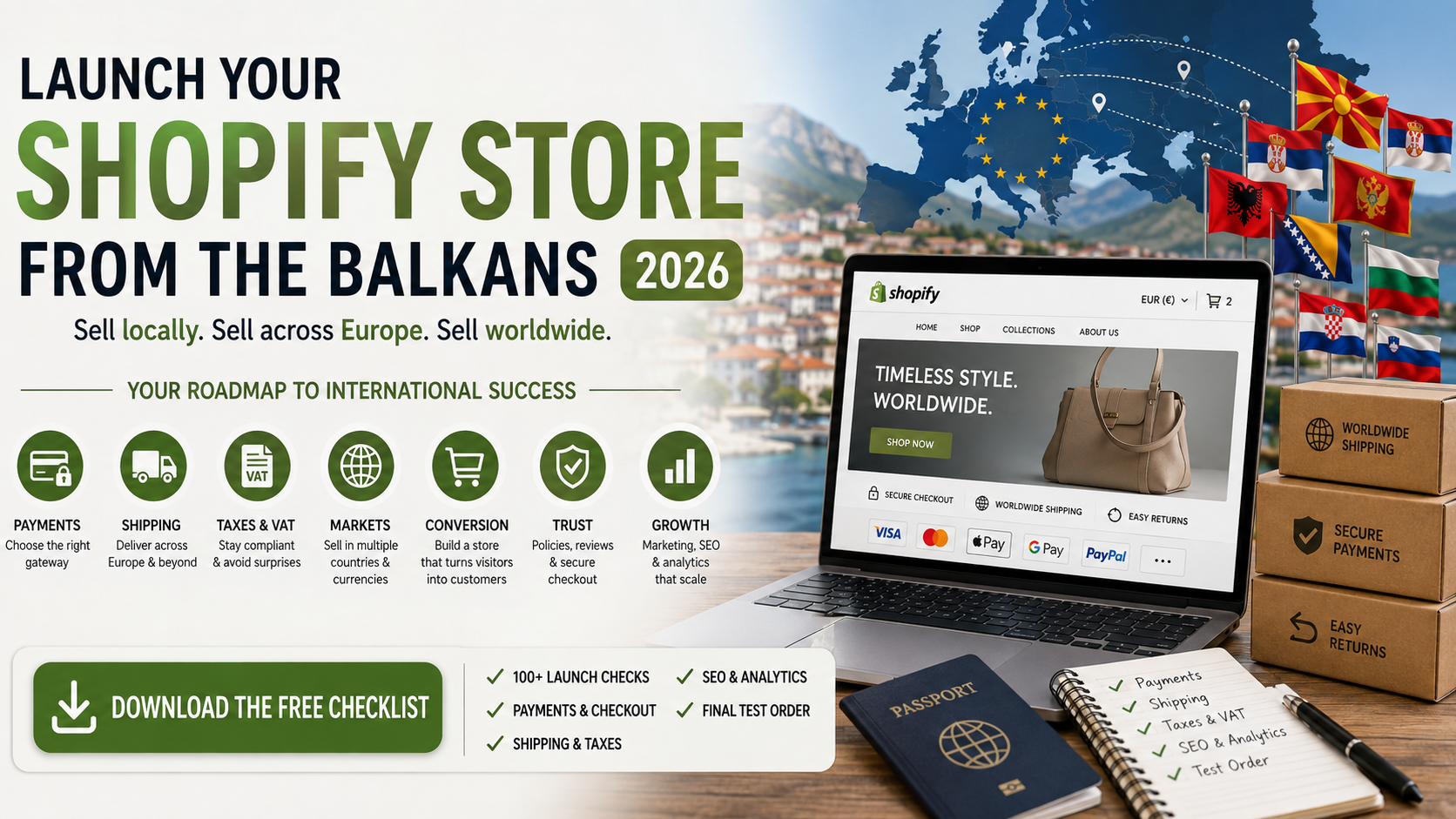
Starting a Shopify store from the Balkans can be an excellent way to build an online business and sell not only locally, but across the European Union and worldwide.
However, launching a Shopify store from countries such as North Macedonia, Serbia, Albania, Montenegro, Bosnia & Herzegovina, Bulgaria, Croatia, Slovenia or other Balkan markets comes with a few challenges that merchants in larger ecommerce markets may not face.
The biggest questions are usually:
- Can I accept card payments?
- Is Shopify Payments available in my country?
- Which payment gateway should I use?
- How can I ship orders across Europe?
- What about VAT and customs?
- Can I sell in EUR?
- How does Shopify Markets work?
- Can I run a successful international store from the Balkans?
The good news is that you can build and operate a Shopify store from the Balkans and sell internationally. The key is setting up your business, payments, shipping, currencies and taxes correctly from the beginning.
In this guide, we’ll explain everything you need to know before launching your Shopify store in the Balkans in 2026.
1. Can You Start a Shopify Store From the Balkans?
Yes.
Shopify is available to merchants around the world, and you can create a store, add products, customize your theme and start selling internationally even if your business is located in a smaller Balkan market.
The important distinction is between Shopify being available in your country and specific Shopify services being available in your country.
For example, Shopify Payments is not available everywhere. Shopify maintains country-specific information about payment providers, and merchants should always check the available options for their specific business location.
This means your Shopify setup may look different depending on whether your company is registered in:
- North Macedonia
- Serbia
- Albania
- Montenegro
- Bosnia & Herzegovina
- Bulgaria
- Croatia
- Slovenia
- Romania
- Greece
- Kosovo
- or another country in the region.
Before building your store, payments should be one of the first things you investigate.
2. Shopify Payments in the Balkans
One of the biggest questions for Balkan Shopify merchants is:
“Can I use Shopify Payments?”
The answer depends on your business’s registered country.
Shopify Payments is Shopify’s native payment solution. Where available, it allows merchants to accept major cards and other payment methods directly through Shopify. Shopify says Shopify Payments supports selling in more than 130 currencies and offers local payment methods depending on the merchant’s market.
However, availability is country-specific.
If Shopify Payments is available in your country, it is generally the simplest payment setup because everything is managed inside Shopify.
If it isn’t available, you will need to use a third-party payment provider supported in your country.
Shopify currently supports more than 100 third-party payment providers globally, with availability varying by country and region.
Important:
Don’t choose a payment provider simply because another Shopify merchant uses it.
A payment gateway that works for a company registered in Croatia may not be available to a company registered in North Macedonia or Serbia.
Your business registration country, bank account, currency and business type can all affect eligibility.
3. What If Shopify Payments Isn’t Available?
This is one of the biggest challenges for merchants in parts of the Balkans.
If Shopify Payments isn’t available for your business location, you can investigate:
- Third-party card payment gateways
- PayPal, where supported
- Local payment providers
- Bank-integrated payment solutions
- Alternative payment methods
- Cash on delivery, where appropriate
Shopify allows merchants to configure payment providers through Settings → Payments, with the available providers determined by the store’s country and configuration.
Don’t try to bypass country restrictions
One common mistake is attempting to register a Shopify Payments account using another country’s address, company or bank account simply because Shopify Payments is available there.
This can create verification, payout and compliance problems.
Your payment setup should match your real business structure and registered location.
If you operate a company in North Macedonia, for example, your payment solution should be compatible with that company rather than being artificially configured as a business in another country.
4. Shopify Payments vs Third-Party Payment Gateways
Which option is better?
Shopify Payments
If available in your country, Shopify Payments offers a highly integrated solution.
Advantages can include:
- Native Shopify integration
- Centralized payment management
- Card payments
- Digital wallets
- Local payment methods where supported
- Multi-currency selling
- Fraud protection
- Simplified setup
Shopify also continues to expand local payment methods in supported European markets. In May 2026, for example, Shopify announced expanded availability of methods including MobilePay, BLIK, TWINT and Przelewy24 in additional European countries.
Third-party providers
Third-party gateways can be useful when Shopify Payments isn’t available.
However, you should compare:
- Transaction fees
- Shopify’s additional transaction fees
- Currency conversion fees
- Payout currencies
- Payout timing
- Refund fees
- Chargeback fees
- Supported cards
- Local payment methods
- Shopify integration
- Customer support
The cheapest gateway isn’t necessarily the best gateway.
A payment method that customers trust and recognize can help increase your conversion rate.
5. Which Payment Methods Should a Balkan Shopify Store Offer?
The answer depends on where your customers are located.
If you’re selling primarily in your home country, local payment preferences are extremely important.
If you’re targeting customers throughout Europe, you should think more internationally.
Depending on your market, you may consider offering:
Credit and debit cards
Visa and Mastercard should generally be considered essential for international ecommerce.
Apple Pay and Google Pay
Digital wallets can make checkout significantly faster, particularly on mobile devices.
PayPal
PayPal can be useful for international customers who prefer not to enter their card details directly.
Bank transfers
These can still be relevant in certain Balkan markets and for higher-value purchases.
Cash on delivery
COD can be important for some local Balkan markets, but it introduces additional operational challenges such as failed deliveries and returned parcels.
Local payment methods
If your target market has a popular local payment method, consider supporting it where possible.
The most important principle is:
Build your payment strategy around your customers, not only around your business location.
6. Selling From the Balkans to the EU
One of the biggest advantages of Shopify is that your business doesn’t have to remain limited to your domestic market.
A company in the Balkans can potentially sell to customers in:
- Germany
- Austria
- Italy
- France
- Netherlands
- Belgium
- Spain
- Sweden
- Denmark
- and other European markets.
But international selling requires more planning.
You need to consider:
- Currency
- VAT
- Customs
- Import duties
- Shipping costs
- Delivery times
- Returns
- Product restrictions
- Consumer protection requirements
- Local payment preferences
This is where Shopify Markets can become particularly useful.
7. Shopify Markets for Balkan Businesses
Shopify Markets allows merchants to configure their international selling strategy by market.
Instead of treating the entire world as one market, you can create different configurations for different countries or regions.
For example:
Market 1 — Domestic
Your home country.
Currency: Local currency
Shipping: Domestic courier
Payment methods: Local payment options
Market 2 — European Union
Countries such as Germany, Austria, Italy and France.
Currency: EUR
Shipping: EU shipping rates
Taxes: Configure according to your tax obligations
Market 3 — United Kingdom
Currency: GBP
Shipping: UK-specific rates
Taxes/customs: Configure appropriately
Market 4 — Rest of World
USD or another suitable currency.
Shipping: International rates
Taxes/customs: Based on destination and your business setup
This gives you much more control over international ecommerce than simply displaying one currency and one shipping rate to everyone.
8. Selling in EUR From the Balkans
EUR is particularly important for Balkan businesses selling internationally.
Even if your company is located outside the eurozone, you may want customers in European markets to see:
€99.00
instead of:
6,100 MKD
or another local currency.
Showing prices in a customer’s familiar currency can make your store feel more local and trustworthy.
Shopify Payments supports multi-currency selling where available, allowing customers to pay in local currencies while merchants can receive payouts according to their configured payout setup.
If you’re using a third-party payment provider, check exactly how currency conversion and settlement work before choosing it.
9. Shipping From the Balkans
Shipping is another major consideration.
A Shopify store can be beautifully designed and have excellent products, but expensive or unclear shipping can still prevent customers from completing their purchase.
Before launching, decide:
Where will you ship?
For example:
- North Macedonia
- Serbia
- Croatia
- EU countries
- UK
- Switzerland
- USA
- Canada
- Worldwide
Which courier will you use?
Depending on your location and product type, you may work with:
- DHL
- UPS
- FedEx
- national postal services
- regional courier companies
- specialized fulfillment providers
The right choice depends on your product size, destination, delivery speed and shipping volume.
10. Free Shipping vs Paid Shipping
There are several common strategies.
Option 1: Free shipping
You include the shipping cost in your product price.
Example:
€119 — Free Worldwide Shipping
This is simple and can be attractive from a conversion perspective.
Option 2: Flat-rate shipping
Example:
EU Shipping — €9.90
International Shipping — €19.90
This makes your costs predictable.
Option 3: Free shipping over a threshold
For example:
Free EU shipping on orders over €100
This can encourage customers to increase their order value.
Option 4: Real-time shipping rates
Customers see shipping calculated according to their destination, package and selected service.
For many growing stores, a combination of these strategies works well.
11. What About Customs and Import Duties?
This is especially important when selling from a non-EU Balkan country to EU customers.
Being physically close to the EU does not automatically mean your shipments are treated as domestic EU shipments.
Depending on the origin of the goods, destination, product category and shipment value, customs duties, VAT and other import charges may apply.
You need to determine whether your customers will pay these charges on delivery or whether you will collect them upfront.
This distinction is often described as:
DDU / DAP
The customer may be responsible for import taxes, duties or fees.
DDP
The seller arranges for applicable duties and taxes to be collected/paid as part of the shipping process.
For international stores, clearly communicating who is responsible for duties and taxes is extremely important.
Unexpected customs charges are one of the fastest ways to create unhappy customers.
12. Taxes and VAT
Taxes are one area where you should not rely on a generic Shopify guide alone.
Your tax obligations depend on:
- Where your company is registered
- Where your customers are located
- Where your products are stored
- Where the products are shipped from
- Your annual turnover
- Whether you sell B2C or B2B
- Whether you are VAT registered
- The type of products you sell
If you’re selling from a Balkan country into the EU, you may have additional VAT and import obligations.
For example, a company located outside the EU may need to consider different rules when selling goods to EU consumers compared with a company established inside the EU.
Our recommendation
Before launching international sales, speak with a qualified accountant or tax adviser who understands:
your home country’s tax rules + EU ecommerce VAT rules.
Shopify can help calculate and display taxes in supported configurations, but Shopify does not replace professional tax advice.
13. Legal Requirements for Your Shopify Store
Before accepting your first order, your store should have the essential legal information customers need.
At minimum, consider:
- Privacy Policy
- Terms & Conditions
- Shipping Policy
- Returns & Refund Policy
- Cookie Policy
- Contact information
- Business information
- Applicable consumer rights information
Your exact requirements depend on the countries where you sell.
If you’re targeting EU consumers, pay particular attention to applicable EU consumer protection, privacy and ecommerce requirements.
Don’t simply copy a policy from another Shopify store.
Your policies should reflect your actual business model.
14. Product Returns From the Balkans
Returns can become more complicated when you’re selling internationally.
Before launching, decide:
- Which countries can return products?
- Who pays return shipping?
- How many days does the customer have?
- Where should returns be sent?
- Are certain products non-returnable?
- How are refunds processed?
- What happens if the product is damaged?
- What happens to customs charges?
For example, if you sell fashion products internationally, you need a clear process for customers returning products from Germany, France or the UK to your Balkan warehouse.
A clear returns policy can increase customer confidence.
15. What Shopify Plan Do You Need?
You don’t necessarily need the most expensive Shopify plan to start.
For a new business, the important thing is getting the fundamentals right:
- Professional theme
- Fast mobile experience
- Reliable payment gateway
- Proper shipping setup
- Product organization
- SEO basics
- Analytics
- Email marketing
- Customer support
- Legal pages
Start with the plan that fits your current needs and upgrade as your business grows.
The goal isn’t to spend as much as possible on Shopify.
The goal is to build a store that converts visitors into customers.
16. How Much Does It Cost to Start a Shopify Store in the Balkans?
Your initial costs can include:
Shopify subscription
Your Shopify plan.
Domain
Usually a relatively small annual cost.
Theme
You can start with a free Shopify theme or invest in a premium theme.
Apps
Depending on your needs, you might need apps for:
- Reviews
- Wishlist
- Filters
- Email marketing
- Customer support
- SEO
- Translation
- Shipping
- Product sourcing
Payment processing
Your payment provider will normally charge transaction or processing fees.
Shipping
Your costs depend on the courier, package and destination.
Marketing
Potential costs include:
- Meta Ads
- Google Ads
- TikTok Ads
- Influencer marketing
- SEO
- Email marketing
Design and development
If you hire a Shopify designer or developer, this becomes another potential startup cost.
The important thing is that you don’t need to build everything at once.
Launch with the essentials and improve the store based on real customer behavior.
17. Choosing a Shopify Theme
For Balkan businesses targeting international customers, your website should look like a global ecommerce brand rather than a small local shop.
Focus on:
Mobile-first design
A large percentage of ecommerce traffic comes from mobile devices.
Fast loading
Avoid unnecessary apps, scripts and animations.
Strong product photography
Images should communicate quality immediately.
Clear navigation
Customers should be able to find products quickly.
Trust signals
Consider displaying:
- Secure checkout
- Authenticity guarantee
- Shipping information
- Returns
- Customer reviews
- Payment methods
Strong product pages
Your product page should clearly communicate:
- Product name
- Price
- Availability
- Product details
- Images
- Variants
- Shipping
- Returns
- Reviews
- Add-to-cart button
18. SEO for Balkan Shopify Stores
Don’t limit your SEO strategy to your home country.
If you want international customers, create content around the markets you want to reach.
For example:
“Buy Designer Bags Online in Europe”
“Authentic Luxury Bags With Worldwide Shipping”
“Designer Fashion Shipping to Germany”
You can also create educational content around problems your customers are searching for.
Examples:
- How to choose an authentic designer bag
- How to identify a fake luxury handbag
- Best designer bags for investment
- How international shipping works
- How to return an international order
- Best payment methods for European shoppers
For Balkan-focused SEO, create country-specific content as well:
Shopify in North Macedonia
Shopify in Serbia
Shopify in Albania
Shopify in Montenegro
Shopify in Bosnia & Herzegovina
This can create a powerful content cluster around your main Shopify guide.
19. Common Mistakes Balkan Shopify Merchants Make
Mistake #1: Choosing the payment gateway last
Payment availability can affect your entire business model.
Check it before investing heavily in your store.
Mistake #2: Using another country’s information
Don’t create a fake business location simply to access a payment provider.
Mistake #3: Ignoring shipping costs
International shipping can destroy your margins if you don’t calculate it correctly.
Mistake #4: Not explaining customs
Customers don’t like unexpected fees.
Make your international shipping and duties policy clear.
Mistake #5: Selling everywhere immediately
You don’t need to target 100 countries on day one.
Start with a few markets you can serve well.
Mistake #6: Installing too many apps
Every additional app can potentially affect your store’s performance and complexity.
Only install apps that solve a real business problem.
Mistake #7: Building a beautiful store without conversion optimization
Design is important, but your store also needs:
- Clear offers
- Strong product pages
- Trust signals
- Good checkout experience
- Reviews
- Clear shipping
- Easy returns
20. A Recommended Shopify Setup for a Balkan Business
A successful Shopify store starts with the right foundation. For a Balkan business planning to sell locally and internationally, the following setup provides a simple and scalable starting point.
1. Business
- Register your business in your actual country.
- Use your correct legal and business information.
- Make sure your bank account and tax information are ready.
2. Shopify Store
- Create your Shopify store using your real business information.
- Choose a theme that works well on both mobile and desktop.
- Set up your products, collections, navigation and checkout.
3. Payments
- Use Shopify Payments if it is available and you’re eligible in your country.
- If Shopify Payments isn’t available, choose a compatible third-party payment provider.
- Make sure the provider supports the currencies and payment methods your customers use.
- Complete verification and test the checkout before launching.
4. Currency
Consider using:
- Your local currency for domestic customers.
- EUR for EU and European customers where appropriate.
- GBP for the UK if you’re actively targeting British customers.
- USD or other currencies for additional international markets when relevant.
Your currency strategy should match the markets you’re targeting and the capabilities of your payment provider.
5. Markets
Instead of treating every customer the same, organize your international sales into clearly defined markets.
A simple structure could include:
- Domestic — your home country
- European Union — selected EU countries
- United Kingdom — UK
- Rest of World — other international destinations
You don’t have to activate every country from day one. Start with markets where you can provide competitive shipping, reliable delivery and suitable payment options.
6. Shipping
Create shipping zones based on the markets you can realistically serve.
For each market, define:
- Available countries
- Shipping rates
- Delivery times
- Free-shipping thresholds
- Courier or fulfillment method
- Return shipping process
- Customs and duties responsibilities
Make sure customers can understand the total shipping cost and expected delivery time before completing their purchase.
7. Taxes
Review your tax requirements before launching.
Configure your Shopify tax settings according to your specific business situation and professional tax advice.
Pay particular attention to:
- Domestic tax requirements
- VAT registration
- EU sales
- Import/export taxes
- Customs duties
- Tax-inclusive or tax-exclusive pricing
Tax obligations can vary significantly depending on where your business is registered and where your customers are located.
8. Policies
Your store should have clear and accessible policies covering:
- Privacy Policy
- Terms & Conditions
- Shipping Policy
- Returns & Refund Policy
- Cookie information where required
- Contact and business information
Your policies should reflect how your business actually operates and the markets you serve.
9. Analytics & Tracking
Set up the tools you need to understand where your customers come from and what they do on your website.
Consider connecting:
- Google Analytics
- Google Search Console
- Google Merchant Center
- Meta Pixel
- Meta Conversions API, where appropriate
Test your tracking before launching so you can accurately measure traffic, add-to-carts, checkouts and purchases.
10. Marketing
Don’t try to advertise everywhere at once.
Start with a focused strategy based on your target market and product.
Depending on your business, this could include:
- Google Ads
- Meta Ads
- SEO
- Email marketing
- Content marketing
- Influencer marketing
- Organic social media
Start with the channels most likely to reach your customers, measure the results and scale what works.
The Goal: Build for International Growth
Your store doesn’t need to launch in every country immediately.
A better approach is to build a solid foundation, start with a few carefully selected markets and expand as your business, logistics and customer base grow.
The ideal setup is simple: build locally, sell internationally, and scale gradually.
21. Can a Balkan Shopify Store Become an International Brand?
Absolutely.
Your business location doesn’t have to define your customer base.
A company based in a Balkan country can sell to customers across Europe and beyond if it has:
- A strong product
- Reliable payments
- Competitive shipping
- A professional website
- Clear policies
- Strong marketing
- Excellent customer experience
The biggest opportunity for Balkan entrepreneurs is not necessarily to compete only in their local market.
It’s to use Shopify as a platform for reaching customers in larger international markets.
Conclusion
Starting a Shopify store in the Balkans in 2026 is absolutely possible, but the strategy needs to be slightly different from launching an ecommerce business in a market where every Shopify feature is automatically available.
The most important thing is to solve payments, shipping, taxes and international selling before you start spending heavily on design and marketing.
Your Shopify store should be built around the country where your business is actually registered, the payment providers available to you, and the markets you want to sell into.
Once those foundations are in place, Shopify gives you the tools to build a professional ecommerce business that can sell far beyond the Balkans.
Start local if you need to, but build with international growth in mind.
Ready to launch your Shopify store?
Don’t miss the details that can cost you sales. Download our free Shopify Store Launch Checklist — Balkans Edition 2026 and make sure your payments, shipping, taxes, SEO, analytics and checkout are ready before you go live.
✓ 100+ launch checks
✓ Payments & checkout
✓ Shipping & taxes
✓ SEO & analytics
✓ Final test order
[ DOWNLOAD THE FREE CHECKLIST ]
Frequently Asked Questions
Can I use Shopify if my business is in the Balkans?
Yes. Shopify can be used by businesses across the region, but individual services such as payment providers vary by country.
Is Shopify Payments available in every Balkan country?
No. Shopify Payments availability is country-specific. Always check Shopify’s current payment-provider information for your business location before choosing your payment setup.
Can I sell to EU customers from the Balkans?
Yes. You can sell internationally from the Balkans, but you need to properly handle shipping, customs, taxes and consumer requirements.
Can I sell products in EUR?
Yes, depending on your Shopify/payment configuration. Multi-currency selling can be particularly useful when targeting European customers.
Do I need a company to start a Shopify store?
This depends on your country and how you intend to operate the business. Before accepting payments, make sure your business and tax structure comply with your local requirements.
What is the best payment gateway for Shopify in the Balkans?
There isn’t one gateway that is best for every Balkan country. The right option depends on your business location, bank, currency, target customers, transaction volume and available payment methods.
Should I sell only in my country first?
Not necessarily. If your product has international demand and you can offer reliable shipping and payments, you can launch with international markets from the beginning. However, starting with a smaller number of markets can make operations much easier.
Important note
Payment availability, tax rules, customs requirements and Shopify features can change. The information in this article is intended as a practical ecommerce guide, not legal or tax advice. Before launching, verify your specific situation with Shopify and a qualified accountant or tax professional in your country.