
How Much Does a Shopify Redesign Cost in 2026?
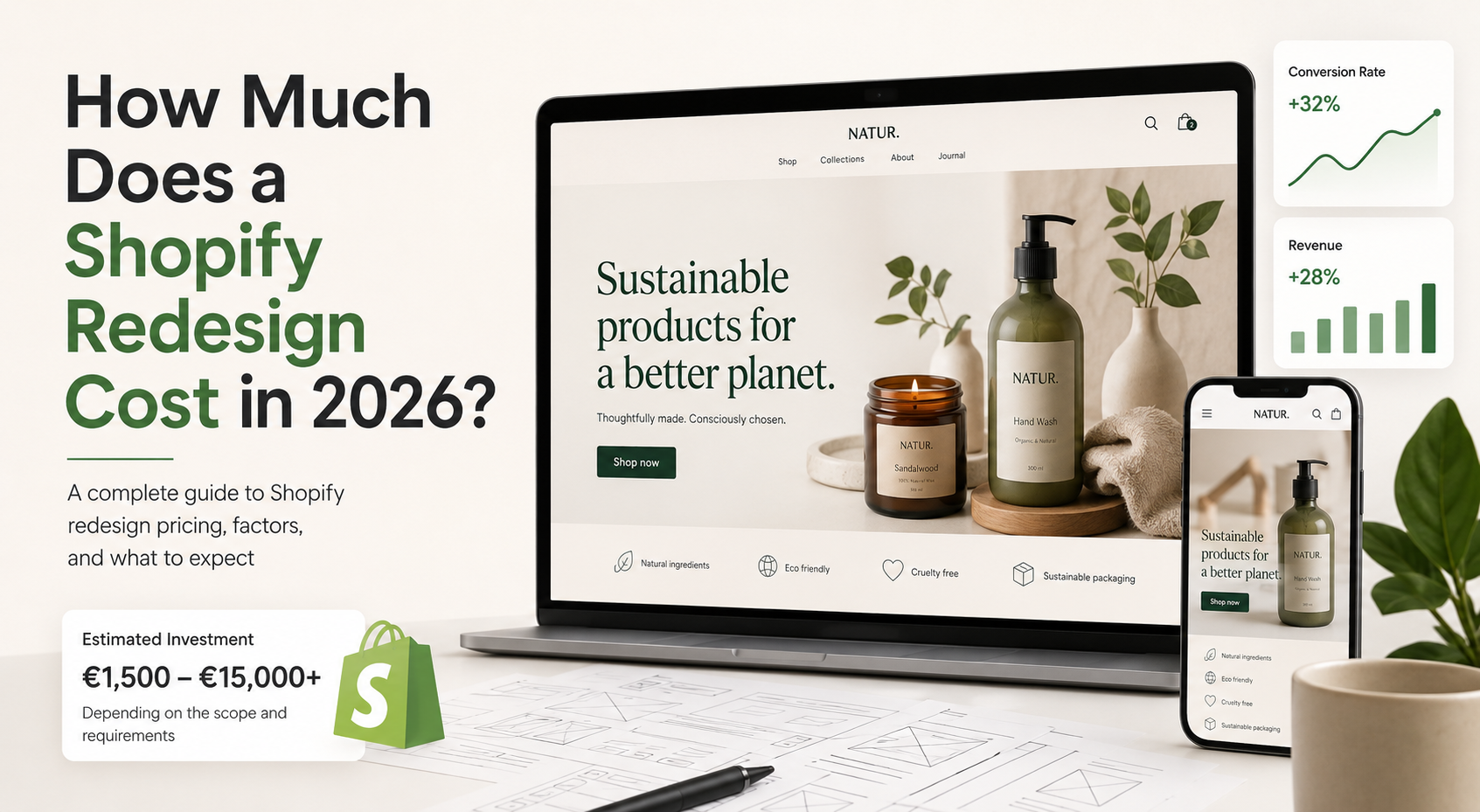
Shopify redesign cost can vary significantly depending on the size of your store, the complexity of the design, and the functionality you need. If your Shopify store feels outdated, loads slowly, is difficult to navigate, or isn’t converting as well as expected, investing in a redesign may be worth considering.
But one of the first questions most store owners ask is:
How much does a Shopify redesign cost?
There isn’t one fixed price. A Shopify redesign can range from a relatively small theme refresh to a completely custom ecommerce project involving UX strategy, custom development, integrations, migration, SEO, and conversion optimization.
In this guide, we’ll explain what affects Shopify redesign pricing and how to decide what level of redesign your store actually needs.
How much does a Shopify redesign typically cost?
A basic Shopify redesign can start from around €1,500–€3,000, while more advanced redesign projects can cost €5,000–€15,000+.
Large or highly customized Shopify stores may cost considerably more.
The final cost depends on factors such as:
- Number of pages and templates
- Theme customization
- Custom Shopify sections
- UX/UI design
- Product catalog size
- Navigation complexity
- App integrations
- Custom functionality
- Product migration
- SEO requirements
- Conversion optimization
- International markets and languages
A store with 50 products and relatively simple requirements will naturally require less work than a fashion retailer managing 20,000 products across hundreds of collections.
1. Shopify theme redesign
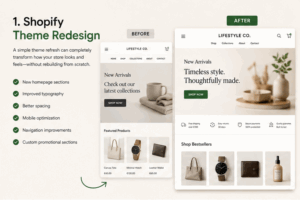
One of the most affordable approaches is improving an existing Shopify theme.
Instead of developing everything from scratch, an experienced Shopify agency can customize the theme to better match your brand and improve the customer experience.
This might include:
- New homepage sections
- Improved typography
- Better spacing
- Redesigned product cards
- Collection-page improvements
- Product-page improvements
- Mobile optimization
- Navigation improvements
- Custom promotional sections
For many small and medium-sized stores, this can provide excellent results without requiring a fully custom theme.
2. Custom Shopify design
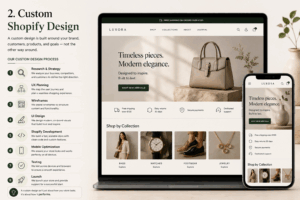
A custom Shopify redesign involves creating a store specifically around your brand, customers, products, and business requirements.
Rather than adapting your brand to an existing theme, the experience is designed around your business.
The process typically includes:
- Research and strategy
- UX planning
- Wireframes
- UI design
- Shopify development
- Mobile optimization
- Testing
- Launch
Custom design becomes particularly valuable when your existing theme is limiting the shopping experience.
3. Product catalog size
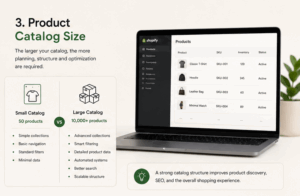
Catalog size can significantly affect the cost of a Shopify redesign.
A store with 30 products is very different from a retailer managing:
5,000, 10,000 or even 50,000+ products.
Large catalogs often require additional work around:
- Collections
- Filters
- Product tags
- Product types
- Vendors
- Metafields
- Search
- Navigation
- Product data
- Automated collections
- Supplier feeds
Poor catalog architecture can make even a beautiful Shopify store frustrating to use.
For large stores, catalog structure should therefore be part of the redesign strategy from the beginning.
4. Custom functionality
Another major pricing factor is custom functionality.
Examples include:
- Product configurators
- Size recommendation tools
- Advanced filtering
- Product quizzes
- Supplier integrations
- Custom search
- Wishlist functionality
- Subscription systems
- B2B functionality
- Custom cart features
- ERP integrations
- Product-feed automation
Some functionality can be implemented using Shopify apps.
Other requirements are better handled through custom development.
A good Shopify agency should help you determine when an app makes sense and when custom development will provide a better long-term solution.
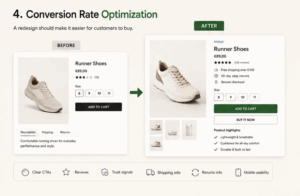
5. Conversion rate optimization
A redesign shouldn’t only make your website look better.
It should make it easier for customers to buy.
Conversion-focused redesigns examine areas such as:
- Calls to action
- Product information
- Product photography
- Reviews
- Trust signals
- Shipping information
- Returns information
- Product recommendations
- Mobile usability
- Cart experience
- Checkout friction
A visually impressive website that creates unnecessary friction can still perform poorly.
Design decisions should support the customer journey rather than simply make the website look different.
Do you actually need a full Shopify redesign?
Not always.
Sometimes the biggest problems can be solved without rebuilding the entire store.
For example, you may only need to improve:
- Homepage hierarchy
- Navigation
- Product pages
- Collection pages
- Mobile UX
- Site speed
- Search
- Product filters
- Trust signals
Before investing in a complete redesign, identify where customers are actually experiencing problems.
Theme customization vs full redesign
Choose theme customization when:
- Your current Shopify setup is technically solid
- Your branding is already established
- Your theme supports most required functionality
- You mainly need UX and visual improvements
Consider a full redesign when:
- Your store looks outdated
- Navigation has become complicated
- Mobile UX is poor
- Your business has significantly changed
- Your theme restricts development
- Your catalog has grown considerably
- Conversion rates are disappointing
- Your brand has outgrown the current website
Is a Shopify redesign worth the investment?
A redesign makes sense when it solves measurable business problems.
For example, improving:
- Conversion rate
- Average order value
- Mobile usability
- Product discovery
- Site speed
- Customer trust
- Organic visibility
can make the redesign far more valuable than simply changing how the store looks.
The goal shouldn’t be:
“We want a new website.”
A better goal is:
“We want a better ecommerce experience that helps more visitors become customers.”
Planning a Shopify redesign?
Before choosing a theme or starting development, identify what is currently preventing your store from performing better.
At Lemon.dev, we design, develop, and optimize Shopify stores with a focus on usability, scalability, and conversion.
If you’re considering a redesign, send us your existing Shopify store and tell us what you’d like to improve.
We’ll help you determine whether you need a complete redesign or whether targeted improvements would be the better investment.