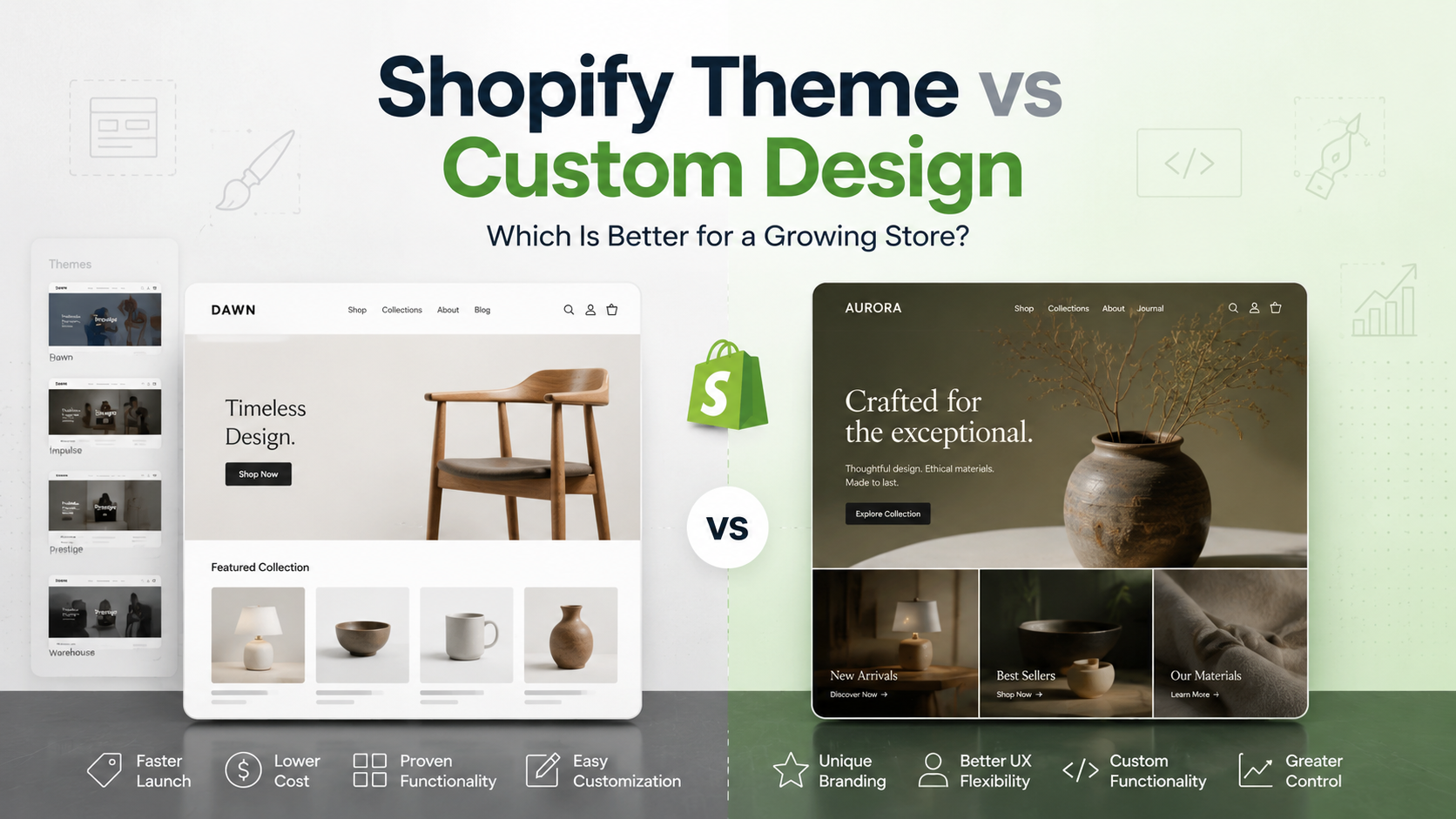
Shopify Theme vs. Custom Design: Which Is Better for a Growing Store?
Choosing how to build your Shopify store is one of the most important decisions you’ll make during a launch or redesign.
Should you use a premium Shopify theme and customize it?
Or should you invest in a completely custom Shopify design?
The answer isn’t as simple as theme vs. custom.
Both approaches can produce high-performing ecommerce stores. The better choice depends on your budget, business stage, customer experience, functionality, catalog complexity, and growth plans.
The real question is:
What does your store need today, and what will it need two or three years from now?
Let’s break it down.
What is a Shopify Theme?
A Shopify theme provides the foundation of your online store.
It typically includes ready-made templates and sections for:
- Homepage
- Product pages
- Collection pages
- Cart
- Search
- Navigation
- Blog
- Promotional sections
- Mobile layouts
Modern Shopify themes are much more flexible than they used to be. With the right theme and development work, you can customize layouts, sections, product experiences, navigation, and other parts of the storefront without building everything from scratch.
For many businesses, that is more than enough.
The advantages of using a Shopify Theme
1. Lower Development Costs
A theme gives you a starting point.
Instead of designing and developing every component from zero, you can work with an existing structure and invest your budget where it matters most.
This can make a theme-based project significantly more affordable than a completely custom build.
2. Faster Time to Market
If you need to launch quickly, a Shopify theme can dramatically reduce development time.
The basic architecture already exists, so your team can focus on:
- Branding
- Content
- Product presentation
- UX improvements
- Custom sections
- Integrations
- Conversion optimization
3. Proven Ecommerce Functionality
Established Shopify themes are built around common ecommerce requirements.
You aren’t starting with a blank canvas. You already have foundations for things such as responsive layouts, product pages, collections, navigation, and cart experiences.
4. Easier Content Management
One of the biggest advantages of a well-built Shopify theme is the Shopify Theme Editor.
Your internal team can usually update sections, banners, content, and merchandising without asking a developer to make every small change.
For growing businesses, this flexibility can save significant time.
The limitations of Shopify Themes
Themes are designed to serve many different businesses.
That is their strength — but it can also become their limitation.
As your business grows, you may eventually encounter:
- Design limitations
- Layout restrictions
- Unnecessary theme settings
- Difficult customizations
- App dependencies
- Generic user experiences
- Performance issues caused by excessive modifications
- Increasingly complex theme code
The problem isn’t necessarily the theme itself.
The problem is what happens when you continuously force a theme to do something it wasn’t designed to do.
At some point, you may spend more time and money working around the theme than you would have spent creating the experience correctly in the first place.
What is a Custom Shopify Design?
A custom Shopify store starts from a different philosophy.
Instead of asking:
“What can this theme do?”
you ask:
“What should this store do?”
The design and development are then built around your:
- Brand
- Products
- Customers
- Business model
- Navigation requirements
- Conversion goals
- Integrations
- Future growth plans
This gives you significantly more control over the storefront experience.
The advantages of Custom Shopify Design
1. Stronger Brand Differentiation
Your website doesn’t have to look like hundreds of other Shopify stores.
Every part of the experience can be designed around your brand — from typography and product presentation to navigation, interactions, and page layouts.
This can be particularly valuable for established brands competing in crowded markets.
2. More UX Flexibility
A custom approach allows you to design the customer journey around how your customers actually shop.
For example, you can create custom experiences for:
- Product discovery
- Complex collections
- Product comparison
- Filtering
- Navigation
- Product recommendations
- Landing pages
- Mobile shopping
Instead of adapting your customers to the theme, you adapt the experience to your customers.
3. Purpose-Built Functionality
If your business has requirements that don’t fit standard Shopify patterns, custom development can provide a better solution.
You can build functionality specifically around your business instead of stacking multiple apps or workarounds onto a theme.
4. Greater Control Over the Storefront
With a custom design, you have greater control over:
- Layout
- Components
- Interactions
- Responsive behavior
- Product presentation
- Navigation
- Performance
- Conversion-focused experiences
That doesn’t automatically make a custom store better.
It simply gives you more freedom.
And freedom becomes more valuable as your requirements become more complex.
Shopify Theme vs. Custom Design: A Quick Comparison
| Shopify Theme | Custom Design | |
|---|---|---|
| Cost | Lower | Higher |
| Launch time | Faster | Longer |
| Flexibility | Moderate to high | Very high |
| Brand differentiation | Moderate | High |
| Customization | Theme-dependent | Purpose-built |
| Maintenance | Generally simpler | More specialized |
| Best for | New and growing businesses | Established/complex businesses |
| Scalability | Good with the right theme | Excellent when built correctly |
The important point is that neither option wins in every category.
The right choice depends on what your business actually needs.
When Should You Use a Shopify Theme?
A Shopify theme is usually the better option if:
- You’re launching a new business
- Your budget is limited
- You need to launch quickly
- Your functionality is relatively standard
- You’re still validating your business model
- You don’t have enough customer data to justify a custom experience
- Your current theme can support your growth plans
A premium Shopify theme combined with thoughtful customization can produce an excellent ecommerce store.
You don’t need a custom website simply because your business is growing.
When Should You Consider Custom Shopify Design?
Custom design becomes more attractive when your store has outgrown its current limitations.
For example, you may want to consider it when:
- Your brand is already established
- Your current website has significant UX problems
- Conversion optimization is a major priority
- Your catalog is large or complex
- You have unusual product requirements
- Your theme is limiting your design
- You’re entering multiple international markets
- You require custom functionality
- You rely heavily on ecommerce revenue
- Your team needs more control over the customer experience
At this point, your website is no longer simply an online storefront.
It’s business infrastructure.
What about a hybrid Shopify approach?
This is where things get interesting.
You don’t always have to choose between a standard theme and a completely custom Shopify build.
For many growing businesses, a hybrid approach can offer the best balance between flexibility, cost, and development time.
You can start with a strong Shopify theme and customize the parts that matter most.
For example:
- Custom homepage sections
- Custom product templates
- Custom collection experiences
- Advanced navigation
- Custom landing pages
- Custom merchandising sections
- Custom cart functionality
- Brand-specific components
This approach allows you to maintain the advantages of a Shopify theme while removing the limitations that affect your specific business.
For many stores, this is the smartest middle ground.
Does Custom Shopify Design convert better?
Not automatically.
This is one of the biggest misconceptions about ecommerce redesigns.
A custom Shopify store doesn’t automatically produce a higher conversion rate simply because it is custom.
A poorly designed custom website can perform worse than a well-optimized premium theme.
Conversion depends on much more than visual design.
Factors include:
- Product-market fit
- Offer
- Pricing
- Traffic quality
- Product photography
- Product information
- Trust signals
- Navigation
- Search and filtering
- Mobile usability
- Page speed
- Checkout experience
- Customer expectations
Custom development simply gives you more control over how these elements work together.
The goal shouldn’t be to build something custom.
The goal should be to build something that works better for your customers.
Don’t choose based on appearance alone
One of the biggest mistakes businesses make during a Shopify redesign is choosing a solution based primarily on how it looks.
A beautiful homepage doesn’t necessarily mean a better ecommerce experience.
Instead, think about where your business is going.
Ask yourself:
Will our product catalog grow significantly?
Will we expand into new countries or markets?
Will we need additional integrations?
Will our team need to create landing pages regularly?
Will we be running continuous CRO tests?
Will our navigation and filtering requirements become more complex?
Can the current theme support those changes without becoming difficult to maintain?
These questions are often more important than choosing between “theme” and “custom.”
So, which Shopify approach is right for you?
Here’s a simple way to think about it:
Choose a Shopify theme if…
You want to launch quickly, control costs, and your requirements are relatively standard.
Choose custom design if…
Your brand, customer journey, functionality, or catalog requires an experience that existing themes can’t provide efficiently.
Choose a hybrid approach if…
You want the speed and reliability of a Shopify theme but need custom experiences in specific areas.
For many growing ecommerce businesses, the hybrid approach is the most practical choice.
The best Shopify Store isn’t necessarily the most custom
More customization doesn’t automatically mean a better website.
And a lower-budget theme doesn’t automatically mean a worse one.
The best Shopify solution is the one that gives your business the right combination of:
Performance + UX + flexibility + maintainability + scalability.
Your website should support your business — not become something your team constantly has to work around.
Need help choosing the right shopify approach?
You don’t necessarily need the most expensive Shopify solution.
You need the solution that makes sense for your business today and your growth tomorrow.
At Lemon.dev, we work with Shopify themes, custom sections, advanced theme customization, and fully customized Shopify experiences.
If you’re unsure whether your store needs:
- A better Shopify theme
- Theme customization
- A hybrid approach
- Or a complete custom redesign
we can help you identify the most practical solution based on your store, requirements, and growth plans.
Send us your current Shopify store and requirements, and let’s determine what your store actually needs — before you invest in the wrong solution.